
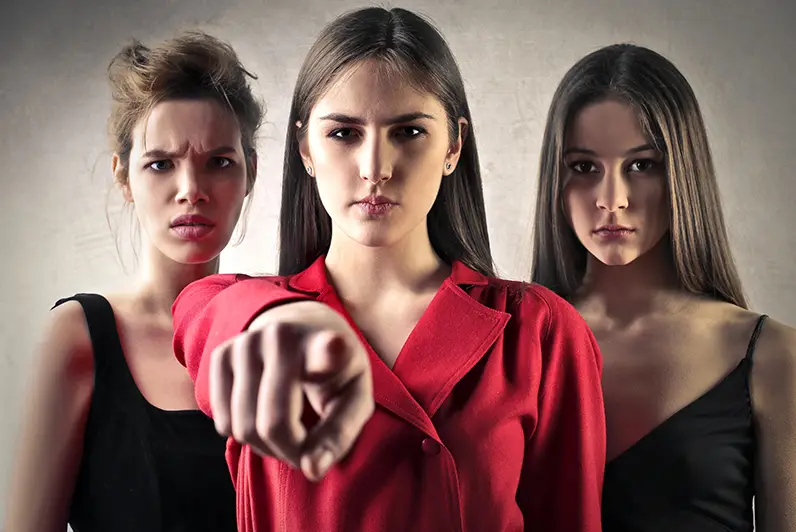
If you live in Los Angeles, you already know how powerful image can be. It defines careers, opens doors, and often dictates who belongs and who does not. Yet behind the glittering image lies a question worth asking: how much of our confidence is real, and how much is performance?
Think back to childhood. Do you remember the queen bee, the girl whose approval felt like gold, and whose rejection could make you feel invisible? Many carry that memory. Some have been scarred by the cruelty of a queen bee, carrying the echo of exclusion into adulthood. Queen bee behavior is not harmless drama; it leaves marks that linger. Yet it is not who a girl truly is. It is a mask, a role, a survival strategy born of fear and reinforced by culture.
But here is the harder truth: queen bee behavior is not limited to schoolyards. It is alive in boardrooms, on red carpets, and across social media feeds. And for some readers, this may be the first time they recognize that the mask of the queen bee is one they have worn themselves.
This is not about judgment. It is about awareness. Queen bee behavior is not who we are. It is a role, a mask, a survival strategy born of fear and fed by culture. When we see it clearly, we have the power to choose differently.
The Illusion of Confidence
The queen bee looks confident. She shines, she controls the room, she draws others into her orbit. Yet what looks like confidence is often a fragile performance. Real confidence is steady and does not need to prove itself.
The queen bee’s power, by contrast, must be constantly managed — deciding who is in and who is out, guarding her image, and maintaining control. Beneath it lies the quiet fear that if the mask slips, she will no longer be enough.
Cultural Roots of the Queen Bee
Queen bee behavior does not arise in isolation. It is the natural outcome of the messages girls absorb from a very young age. These messages come from every direction, family, media, school, and the larger culture.
- Family patterns. Some parents, often with good intentions, tie love and approval to performance. “Be the best” becomes a silent condition of worth. Girls learn to equate achievement with love and may fear that failure means rejection.
- Media influence. From movies to fashion magazines to Instagram feeds, children are bombarded with images that sexualize them and glorify beauty above character. Value becomes tied to appearance, likes, and attention.
- Peer culture. Schools often reward competition over collaboration. Sports, academics, and even friendships can become arenas where status matters more than connection.
- Societal conditioning. We live in a culture that constantly pits girls and women against one another. Movies, television, and advertising frame women as rivals for attention, success, or love. Influencers and social media amplify the message that worth comes from followers, likes, and curated images. Comparison is woven into nearly every platform, and collaboration is rarely celebrated with the same intensity.
This constant exposure shapes how children see themselves and each other. They learn that to belong, they must compete. They learn that beauty, status, and influence hold more value than kindness, creativity, or authenticity. The queen bee is not born in the classroom; she is created by a culture that rewards image over essence.
These forces weave together into a powerful narrative: you must control, perform, and outshine in order to belong. For a child, this is not strategy but survival. What we call queen bee behavior is, at its root, an attempt to secure safety in a world that has told her she is never enough as she is.
The Cost of the Illusion
The mask of the queen bee creates harm on all sides. For those targeted, the sting of exclusion can echo for years. Many carry the weight into adulthood as mistrust of other women, fear of rejection, or the quiet belief that they are not enough. What felt like schoolyard drama at the time often leaves scars that shape relationships for decades.
Yet the cost is just as real for the girl in the queen bee role. Living behind a mask of control denies her the very thing she most longs for: authentic connection. When influence depends on fear and status, friendships can never feel safe. Beneath the surface of popularity lies isolation. The tragedy is that no one wins. Those excluded doubt their worth, while the queen bee herself never feels free to be seen for who she really is.
A Mirror for Us All
Queen bee behavior is not confined to schoolyards. It shows up in boardrooms, in politics, on film sets, and across social media. The dynamics are the same: image over authenticity, control over collaboration, dominance over care. What begins as relational aggression in childhood becomes performance culture in adulthood.
Los Angeles, perhaps more than any other city, amplifies this energy. Image is currency here. Followers, roles, awards, and appearances can determine belonging as surely as the queen bee once decided who could sit at her lunch table. We see the same masks, the same performances, the same fragile confidence hiding fear.
Toward a Different Future
I do not write this to condemn anyone. My role is to shine a light on behavior, on the masks we wear, and on the ways those masks harm us. Queen bee behavior may seem like control or confidence, but in truth it costs everyone. It wounds those who are excluded, and it isolates the one behind the mask.
When we recognize this, we are no longer trapped in it. Awareness opens the door to a gentler way of being — one rooted in authenticity, in valuing people for who they are, and in creating belonging that is real. If culture can create the queen bee, culture can also transform her. And that work begins within each of us.

Angela Legh, International Bestselling Author, Motivational Speaker, and Television Show Producer, passionately promotes emotional intelligence through her book series The Bella Santini Chronicles and her TV show Unfiltered Parenting
Angela – Thanks for this post. As a storyteller, I understand the importance of what you’ve written. How we present ourselves is key to the stories we’re telling.
You’ve also captured the importance of understanding our attachment to image! When I lived in LA, I felt naked if I went to Trader Joe’s without makeup. I still wear makeup (not to Trader Joe’s LOL) but as an expression of my beauty. Not a covering. My authentic self is one I value and trust.