
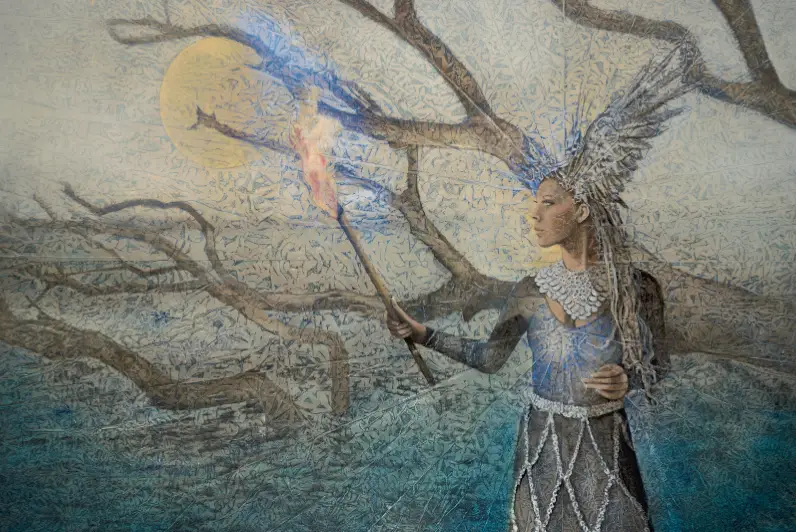
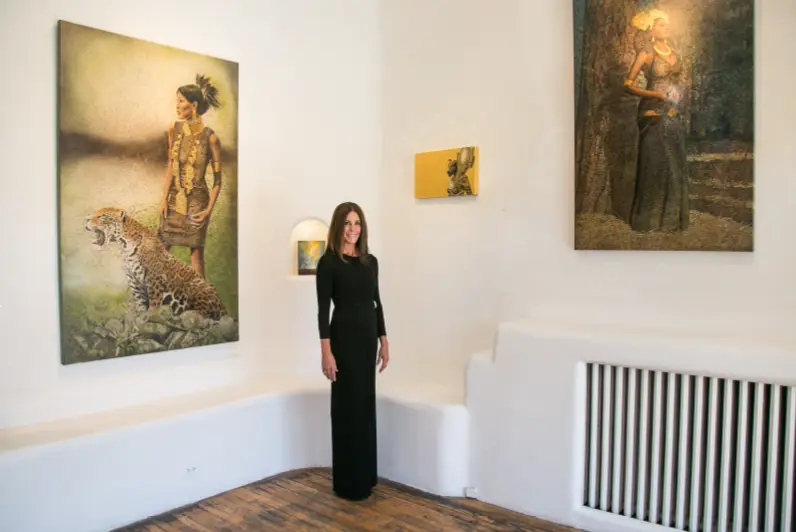
When you walk into Kimberly Webber’s Taos gallery, the air carries a quiet strength, part mountain energy and part reverence. Light moves across large canvases where archetypal figures, animals, and symbols take shape in quiet dialogue. The paintings do not shout. They hum with awareness. Each one feels less created than revealed, a prayer unfolding in color and time.
“Nature is my church,” Kimberly said. “It is the most sublime reflection of the Creator.”
To Kimberly, the natural world is a mirror of divine intelligence, revealing how everything is connected. The rhythm of wings, the curve of a mountain, or the calm gaze of a wolf all carry messages about balance and belonging. That deep reverence informs every brushstroke. Each painting serves as both a personal prayer and an offering for humanity.
Early Life and Artistic Roots
Kimberly began painting at the age of three. Her grandmother, a seamstress and embroidery artist, gave her a set of paints and encouraged her creativity. Her parents also nurtured her creative spirit, never trying to steer her away from art but instead giving her the freedom to explore it fully. She grew up surrounded by animals, especially horses, which she loved to paint. “I was lucky,” she said. “My family supported my art from the beginning.”
By high school, her dedication was evident. She earned the Governor’s Award in Ohio for her portfolio and later received a Bachelor of Fine Arts in Painting from Ohio Wesleyan University. During college, she studied in Florence, Italy, where she learned traditional oil painting, and spent a semester in New York City working at ELLE magazine. A minor in marketing added a practical foundation to her artistic path.
A Fusion of Traditions
After graduation, Kimberly met Taos painter KC Tebbutt, who introduced her to an artistic lineage rooted in classical Asian brush and rice-paper techniques. Through this influence, she discovered a way to merge those teachings with her oil-painting background.
“When KC showed me the rice-paper technique, I immediately understood it,” she said. “It felt like something I had known before.”
Her process begins with a charcoal drawing on handmade rice paper. She layers pigment on both sides of the sheet to create depth, then folds and unfolds it to build texture. The resulting lines become guides for her calligraphic marks. Once complete, the paper is mounted to a panel, forming the foundation for layers of luminous oil paint.
Each painting is structured according to the proportions of the golden mean, the same principle Leonardo da Vinci illustrated in his Vitruvian Man, where art and mathematics meet in perfect harmony. “These ratios exist within the human body,” she explained. “When people view them, there is a natural feeling of harmony.”
Kimberly uses traditional materials such as lapis from Egypt, gold from Italy, and natural resins and beeswax. “These materials hold energy,” she said. “They contribute to the vibration of the painting.”
The Call to Taos
Kimberly first came to Taos in 1993 after feeling an inner pull to move there. “I had never been to New Mexico,” she said. “I just knew I had to go.”
Within a day of arriving, she had found a place to stay, a studio in the mountains, and a sense of belonging. “The land here is sacred,” she said. “I thank the ancestors each time I go outside. I thank my own ancestors for bringing me here, and I pray for those who will come after us.”
The landscape continues to shape her art. “The light here changes everything,” she said. “It is why the paintings feel alive.”
Art as Prayer
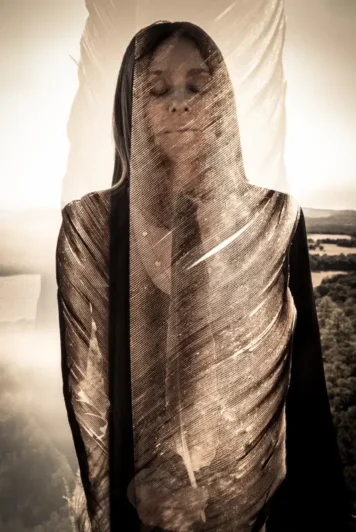
Every piece begins with a prayer. “I create a sacred space before I paint,” she told me. “Then I ask to get out of the way so divine energy can flow through.” Her work explores the meeting point between the seen and unseen, translating energy, emotion, and presence into visual form.
She sees her role as a channel for something greater. “I may never meet the person who lives with one of my paintings,” she said. “My prayer is that the image helps them remember their own divinity.”
Her subjects often include divine or mythological figures such as Isis, Osiris, and Christ. “Isis is my girl,” she said with a smile. “The story of Isis and Osiris is the same story of resurrection and love that continues through time.”
Kimberly describes art as a form of spiritual service, a way to embody light and transmit higher consciousness through beauty. Her work has been exhibited internationally and is represented by ACA Galleries in New York City and Exposures Fine Art in Sedona, Arizona. Her paintings are included in private and institutional collections around the world.
The Priestess of Light
Kimberly’s work reached a global audience through the Priestess of Light Oracle Deck, published by Hay House. The deck includes fifty-three of her paintings, each paired with interpretive text written in conjunction with author Sandra Anne Taylor.
“At first I thought the simplified writing might not convey all the depth,” Kimberly said. “Then I realized it made the images accessible to everyone.”
The project was blessed in India by Amma Sri Karunamayi, who confirmed the title Priestess of Light. The deck became a bestseller and is now being considered for reissue by the authors.
Beauty as a Living Language
Kimberly Webber’s art weaves Eastern and Western traditions into one visual language, where ancient rice-paper calligraphy meets the classical discipline of oil painting. The result is a bridge between precision and intuition, between thought and devotion.
“Art is not about me,” she said. “It is about awakening something sacred in others.”
To her, painting is a conversation without words. An image can touch what speech cannot, inviting reflection or rekindling awe. That quiet exchange is what keeps her returning to the canvas, the hope that light and color might open something true in another person.
In her Taos gallery, surrounded by paintings that seem to hold their own quiet radiance, her purpose is evident. Each work is both creation and conversation, a reminder that beauty is not only seen but felt, and in that feeling, grace becomes visible.
Learn more at kimberlywebber.com

To cover different events and add a variety of expertise to the news and stories we report, we have several staff writers who contribute to our publication.