
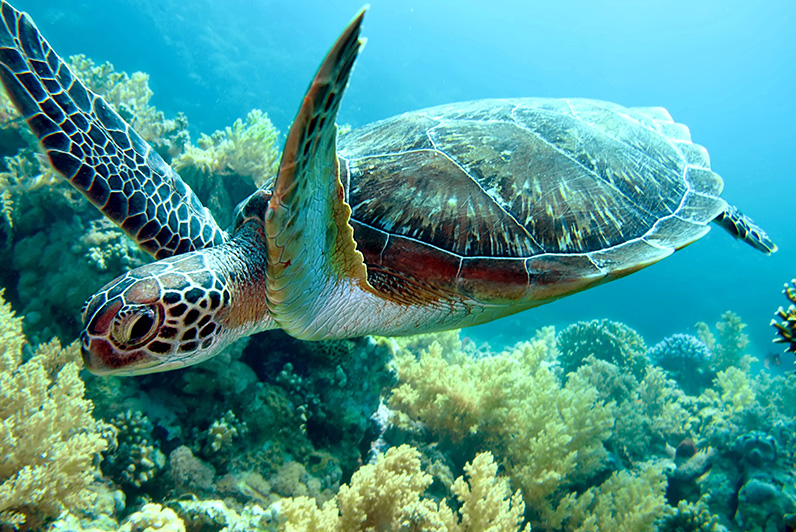
A decade ago, a simple message spread across social media and coffee shops. Skip the plastic straw to save the turtles. The campaign gained momentum around 2015, when viral images of sea turtles entangled in plastic or with straws lodged in their noses sparked global attention. Suddenly, refusing a straw became a simple and tangible way to help. It was easy, symbolic, and felt powerful.
Environmental movements often begin this way. A complex global problem becomes connected to one visible habit that people can change immediately. The action itself may be small, but it gives individuals a way to participate in something much larger than themselves.
But more than a decade later, it raises a natural question. Where are the turtles now, and do small actions like this really make a difference?
Sea turtles are some of the most ancient creatures on Earth, having existed for more than 100 million years. All seven species, including hawksbill, loggerhead, leatherback, green, Kemp’s ridley, olive ridley, and flatback turtles, face threats from habitat loss, climate change, fishing nets, and plastic pollution.
In the United States, conservation programs have made meaningful progress. Kemp’s ridley sea turtles, once critically endangered with fewer than 200 nesting females in the 1960s, now see more than 20,000 nests annually along the Gulf Coast. Green turtle nesting populations in Florida have more than doubled since the 1980s thanks to protected beaches and conservation programs. Leatherback turtles remain vulnerable, but international protections and nesting beach monitoring have helped stabilize some populations.
Individual actions such as skipping plastic straws might seem small compared with the vastness of the ocean. Plastic straws represent only a small fraction of the total plastic found in marine environments, but they became a gateway to wider awareness. Campaigns to reduce single use plastics encouraged reusable cups, bags, and more mindful consumption. In that sense, the straw was never the full problem. It was a starting point for a cultural shift.
While individual habits matter, large scale waste reduction also depends on how businesses and cities manage packaging and recycling systems.
The United States has seen broader sustainability efforts that have made measurable environmental impact. Whole Foods has long emphasized compostable packaging, plastic reduction, and in store recycling programs. Chipotle encourages customers to recycle packaging and has introduced compostable bowls in many locations. Starbucks, Target, and Trader Joe’s have introduced reusable cup incentives or initiatives aimed at reducing single use plastics. Cities such as San Francisco and Seattle have implemented mandatory composting and stricter recycling programs that significantly reduce organic waste that would otherwise end up in landfills.
These systems can produce measurable results. The United States currently recycles about 32 percent of its municipal waste. Countries such as Germany recycle roughly 56 percent, and South Korea more than 60 percent. Millions of tons of waste have been diverted from landfills and incinerators in the United States, preventing more than 190 million metric tons of carbon dioxide equivalent emissions in 2021 alone, according to the Environmental Protection Agency.
Public awareness campaigns play an important role in making these systems work. When people normalize recycling, composting, or carrying reusable items, those small habits help support larger environmental infrastructure.
As of 2026, sea turtles are still here.
On protected beaches in Florida, Texas, and parts of the Caribbean, conservation volunteers often gather before sunrise during nesting season. As the sand begins to stir, tiny hatchlings emerge and instinctively crawl toward the ocean, guided by the natural light on the horizon. Many will not survive the journey through predators and rough currents, but each successful crawl represents a fragile victory for conservation efforts that have taken decades to build.
Thousands of hatchlings emerge each year on protected beaches, and some populations are slowly recovering. At the same time, millions of marine animals around the world continue to be affected by plastic debris, while climate change alters ocean temperatures, nesting patterns, and food availability.
Conservation therefore remains an ongoing effort that requires policy, scientific research, community engagement, and individual awareness.
So where are the turtles now?
They are still struggling, but they are also benefiting from decades of conservation work and growing public awareness. Campaigns like the movement to skip plastic straws were never really about the straw itself. They were about encouraging people to think differently about waste and environmental responsibility.
Small actions alone will not solve the problem, but they often spark the awareness that leads to larger change. When individual choices are paired with stronger recycling systems, better waste management, and policies that protect marine habitats, the combined impact becomes meaningful.
The ocean may be vast, but collective action shows that even small efforts can ripple outward in ways we do not always see.

To cover different events and add a variety of expertise to the news and stories we report, we have several staff writers who contribute to our publication.