
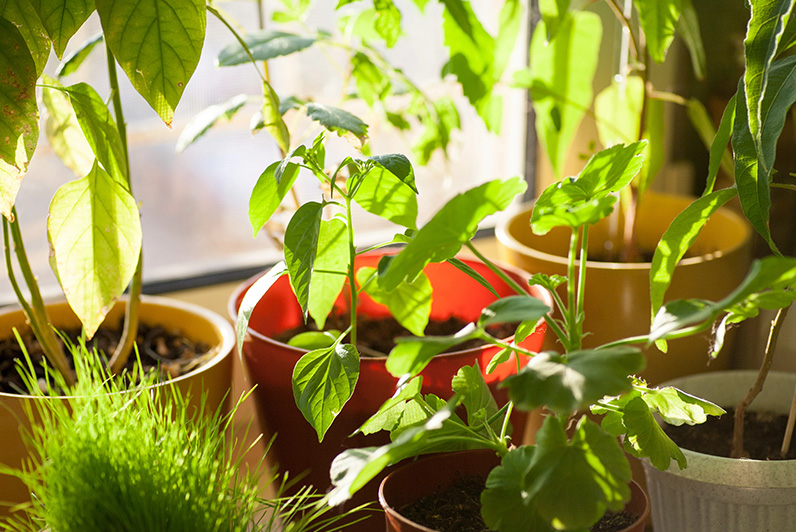
At some point, owning thriving plants became a quiet flex. Not long ago, houseplants were disposable, picked up on a whim, replaced when they died, rarely mourned. Now they’re indicators of care, patience, and a certain steadiness. Being a “plant mom” has become an identity, a signal that someone can nurture life consistently in a world that rewards speed and distraction. Scroll through social media or walk through any city, and it’s visible everywhere: living rooms crowded with monstera and fiddle-leaf figs, balconies transformed into small jungles, cafés dripping with vines. Healthy plants have become shorthand for wellness.
You notice the plants before you notice the house. Tomato vines twist up trellises, lavender spills from terracotta pots, and dahlias bloom in bursts of coral and magenta along the porch. The space feels alive, as if it’s breathing alongside the people inside it. The air carries hints of rosemary and peach blossoms, and every surface seems to pulse with green life. Spending time here, it becomes clear that the plants aren’t just decoration, they reflect the environment they’re growing in and the care of those tending them.
I haven’t always understood that language. I’ve bought plants with good intentions and watched them fade within weeks. I followed the care instructions, adjusted the light, changed the soil. When they declined anyway, I took it as a verdict. In my home, a struggling plant felt like a problem to solve or something to discard and try again later.
It makes me wonder what really helps something grow. Is it sunlight and water alone, or something less visible, patience, timing, a willingness to observe without interfering? Being a “plant person” has become a cultural identity, a signal of stability and care. You see it everywhere: balconies overflowing with greenery, living rooms anchored by thriving leaves, cafés where vines trail from ceiling hooks. Plants have become a form of wellness, a tangible way to nurture something in a world that often feels disconnected. Even among devoted plant owners, there’s a quiet divide. Some respond to a struggling plant with panic; others respond with trust.
There are theories for this. Some believe plants sense energy or intention, detecting calm and chaos in subtle ways. Others point to research showing that plants communicate through chemical signals, respond to touch, and react to vibrations. Ideas once dismissed as mystical now feel less abstract. Plants may not experience the world as we do, but they are attuned to their surroundings. They register change, adapt, and wait.
I’ve learned this most clearly by watching my sister relate to her plants when they don’t look their best. Leaves shrivel, stems harden, and the soil looks tired. At my house, those plants would be thrown away, written off as dead. She doesn’t rush to conclusions. She doesn’t panic or overcorrect. She’ll say, almost casually, that it isn’t their season, that they’re resting or conserving energy, and that they’ll return in the spring. And somehow, they do. What looks like neglect from the outside is often restraint.
Of course, there are practical explanations too. Good soil, proper drainage, compost, and light all matter. She knows the mechanics, saving eggshells, mixing coffee grounds, paying attention to placement. But those tools only work because they’re paired with patience. Care isn’t reactive. It’s consistent. It allows for dormancy without labeling it failure.
It’s easy to scoff at ideas like patience or intuition in a culture that values constant output. But plants operate on a different timeline. They remind us that not everything responds to urgency. When someone resists the impulse to fix or discard something simply because it looks unproductive, they’re practicing a different kind of care, one rooted in trust rather than control.
That approach changes how a space feels. A home shaped by that attention feels steady, even when things are imperfect. Growth isn’t forced. Decline isn’t punished. There’s room for cycles, for rest, return, and renewal. It isn’t perfection that sustains living things, but consistency.
In that way, plants become mirrors. They reflect how we respond to uncertainty, whether we rush to intervene, give up too quickly, or allow time to do its work. They teach that growth isn’t linear, and stillness isn’t stagnation. When I think about the plants I’ve lost, I realize I treated them like décor rather than living things. I wanted immediate proof of success. Plants don’t operate that way. They ask for presence without guarantees.
Perhaps that’s why so many people are turning toward plants now. Tending something living requires patience in a culture obsessed with speed. You can’t rush photosynthesis. You can’t scroll your way to blooming. Growth happens quietly, often invisibly, until one day it doesn’t.
Being surrounded by healthy plants changes how a space feels. Studies show greenery can lower stress, improve mood, and sharpen focus but the effect is noticeable even without data. Rooms with living plants feel calmer. Time seems to slow. Breathing feels easier. Plants don’t respond to urgency or perfection; they respond to consistency. They reward those who notice small changes and respect natural cycles.
In that way, plants teach us something about ourselves. Growth doesn’t happen on command. Dormancy isn’t failure. Care doesn’t always require intervention. Sometimes it requires restraint. Living alongside plants invites a different pace, one that prioritizes observation over control, patience over productivity. Spaces filled with thriving greenery feel restorative. They don’t just improve our surroundings; they quietly recalibrate us. They show what’s possible when we create environments, inside and out, that allow life to unfold in its own time.

To cover different events and add a variety of expertise to the news and stories we report, we have several staff writers who contribute to our publication.