
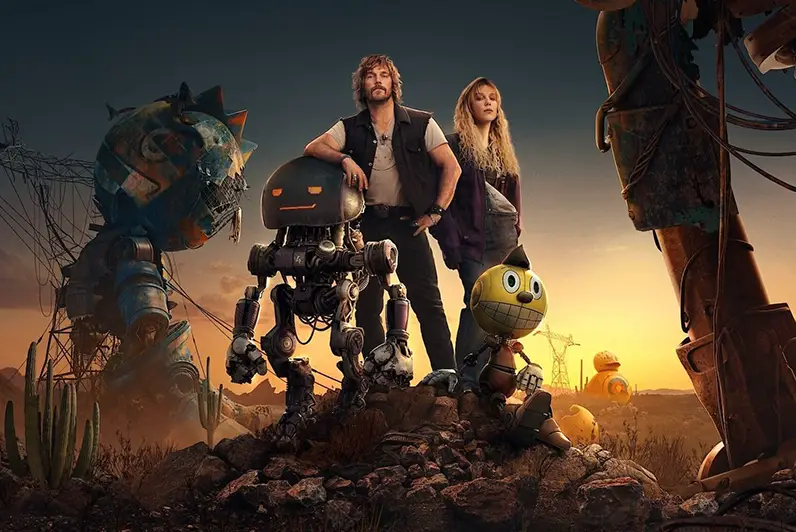
Before the summer blockbusters splash across big screens nationwide, you may be wondering what to watch on your streaming services. With so many choices, we might overlook something we would enjoy. There are many reasons to consider Netflix’s March release, The Electric State, which certainly made a striking entrance into the science fiction world. It’s not just visually stunning, but given the talent behind it, there were also huge expectations.
Directed by the Russo brothers, known for Avengers: Endgame, and written by Christopher Markus and Stephen McFeely, the film brings to life the unique and somewhat hauntingly nostalgic vision of Simon Stålenhag’s 2018 graphic novel. Interestingly, despite its massive $320 million budget, making it Netflix’s most costly original movie to date, The Electric State has divided viewers and critics. It has generated a lot of conversation across the entertainment scene.
The Cast and Creative Team
One of the film’s greatest strengths is its impressive cast, led by Stranger Things star Millie Bobby Brown. She plays Michelle, a young woman traversing a dystopian America, and her performance is both captivating and emotionally resonant, providing a solid core to the story’s chaotic setting.
Chris Pratt joins Brown as Keats, a resourceful smuggler who becomes her unlikely ally.
The supporting cast is just as impressive, featuring:
Ke Huy Quan, riding high on his Oscar win
Woody Harrelson, bringing his signature intensity
Anthony Mackie, lending his voice to the sentient robot Herman
And a supporting cast including Brian Cox, Jenny Slate, Jason Alexander, Giancarlo Esposito, and Stanley Tucci.
The Russo brothers, reuniting with writers Markus and McFeely, aim to blend a classic coming-of-age narrative with a visually stunning, retro-futuristic world.
Plot and Style
Set in an alternate 1990s America where robots once coexisted with humans, The Electric State tells the story of Michelle and her journey to find her missing brother. Alongside a friendly robot named Cosmo and the smuggler Keats, Michelle travels through a decaying landscape filled with remnants of a failed AI uprising and government surveillance. The aesthetic, heavily inspired by Stålenhag’s haunting artwork, merges 90s Americana with desolate tech ruins.
Visually, the film is striking. Cinematographer Trent Opaloch brings a painterly quality to the scenery, capturing the scope and loneliness of a post-industrial world. The use of CGI and practical effects is ambitious, though not without criticism, as some viewers found the robot designs to lack originality.
Critical and Fan Reception
The reception to The Electric State has been sharply divided. On Rotten Tomatoes, the film holds a disappointing 15% score from critics over 144 reviews, while the audience score sits at a more favorable 68%. Critics widely pointed to the film’s slow pacing, muddled plot, and what many described as “emotional shallowness.”
Several reviews pointed out that the film tried to juggle too many tones at once, shifting awkwardly between moody introspection and blockbuster spectacle. The New York Post called it a “$320 million bore,” criticizing its lack of coherence and over-reliance on visual effects.
Yet, fans have been kinder. On platforms like Reddit and social media, many have praised the film’s atmosphere and the lead performances. Brown’s portrayal of Michelle was frequently cited as a highlight, with viewers appreciating her emotional range and natural charisma.
Some fans also defended the film’s slower pace, arguing that it mirrored the melancholy, contemplative nature of the source material. Still, there was broad agreement that the story could have been more tightly constructed.
Budget and Box Office Performance
With a reported budget of $320 million, The Electric State holds the dubious honor of being the most expensive film ever released by Netflix. This colossal investment was intended to create a tentpole film on par with major theatrical releases.
However, its performance has been underwhelming. During its debut weekend, the film garnered only 25.2 million global views, a figure that falls short when compared to other Netflix hits like Red Notice or Extraction. While Netflix does not release detailed box office numbers (as it is a streaming-first platform), industry analysts have called the film a commercial disappointment based on viewership metrics.
Given the rising production and marketing costs for streaming content, many industry insiders are questioning the sustainability of such mega-budget projects for platforms that do not rely on ticket sales.
Controversies and Talking Points
One of the major controversies surrounding The Electric State is its deviation from the original graphic novel. While Simon Stålenhag’s book is a quiet, atmospheric experience centered on themes of loss and memory, the Russo brothers opted for a more action-driven, emotionally overt narrative. Fans of the book criticized this choice, claiming that the filmmakers missed the subtlety and thematic richness of the source material.
Another point of contention was the film’s visual design. While many applauded the cinematic scope, others found the color grading too drab and criticized the design of robots and animatronics as “uninspired.” For a film that leaned heavily on its visuals, this was a significant drawback.
Additionally, some accused Netflix of greenlighting the project based more on the star power of the Russos and the cast than on the strength of the script or concept. This has reignited debates over the streaming giant’s strategy of pouring money into spectacle rather than substance.
Final Thoughts
The Electric State is a classic example of high-risk, high-reward filmmaking in the streaming era. With an all-star cast, celebrated directors, and a beloved source material, it had all the ingredients for success. But the execution— marred by uneven storytelling and a controversial creative direction— left many underwhelmed.
As Netflix continues to experiment with big-budget original content, The Electric State will likely serve as both a cautionary tale and a learning opportunity. While it may find a cult following in years to come, for now, it stands as a visually bold but emotionally inconsistent entry in the sci-fi canon.

To cover different events and add a variety of expertise to the news and stories we report, we have several staff writers who contribute to our publication.