
A new story is being written for the future of Africa and the United States of America.
With Black History Month coming to a close, I feel inspired to share a moment that reshaped my understanding of Africa’s role in the future of the U.S. and the world. For a moment, I’d like you to time travel with me back to December 2022, when I had the opportunity to attend the US Africa Summit in Washington, D.C. as the attaché to a billionaire investment banker and his delegation.
First, a bit about my background. At just one year of age, my family moved to Cameroon, a French-speaking African nation, where we spent six years as missionaries. This experience was a stark contrast to the African-American culture I’ve encountered here in Los Angeles. While both share in African heritage, the cultural differences were striking. Yet, neither fully prepared me for the level of African excellence I would witness on Capitol Hill.
As an Angeleno, it’s clear this city thrives on entertainment. When Africa comes up in conversation, many instinctively think of Afrobeats or Wakanda Forever. And while Burna Boy selling out the Hollywood Bowl and Black Panther dominating the box office are powerful cultural moments, they only scratch the surface of Africa’s global impact.
Having immigrated to the U.S. from Bermuda in pursuit of opportunity and value creation, I’ve naturally developed a deep interest in cross-continental growth. History has long shown that the world’s most influential economies were shaped by global trade networks like the Silk Road, the Transatlantic Trade Route, and the Trans-Saharan trade. Today, Africa is stepping into a new era of global influence, with pop culture fueling a renewed interest in its economic and cultural contributions. The rise of Afrobeats, the blockbuster success of Black Panther, and a growing media spotlight are shifting the narrative around Africa’s role in the U.S. and beyond.
Eager to gain a deeper understanding of Africa’s impact on the U.S. market, I agreed to travel to Washington, D.C. on behalf of a client, for an experience that would forever change my perspective.
Now, it’s time to rewind the clock. It’s late in the afternoon on December 15, 2022 as I sit in the hotel lobby, trying to decompress after three days of little sleep, back-to-back high-profile political meetings, and more Secret Service checkpoints than an episode of Scandal. My mind is still catching up, and I’m doing my best to put it all into words. For the first time since the COVID-19 pandemic, the U.S. Government hosted some of the most influential political and business leaders from the continent of Africa in Washington DC. The US Government is making strides by acting on their invested interest in exploring the growth opportunities within the rapidly developing African economy.
In an official release earlier in June 2022, the Export–Import Bank of the United States (EXIM US) stated that, “Today’s global financing challenges require whole-of-government solutions and partnerships with like-minded nations that share America’s commitment to high project standards, sustainability, and delivering the best goods and services available.”
During this same week EXIM US delivered on these words by hosting their Annual Conference on the eve of the US Africa Summit, which had an official address by President Joe Biden. EXIM US sheds light on their vision for the coming years with the words, ‘A brighter future through exporting’, as a slogan for this year’s conference.
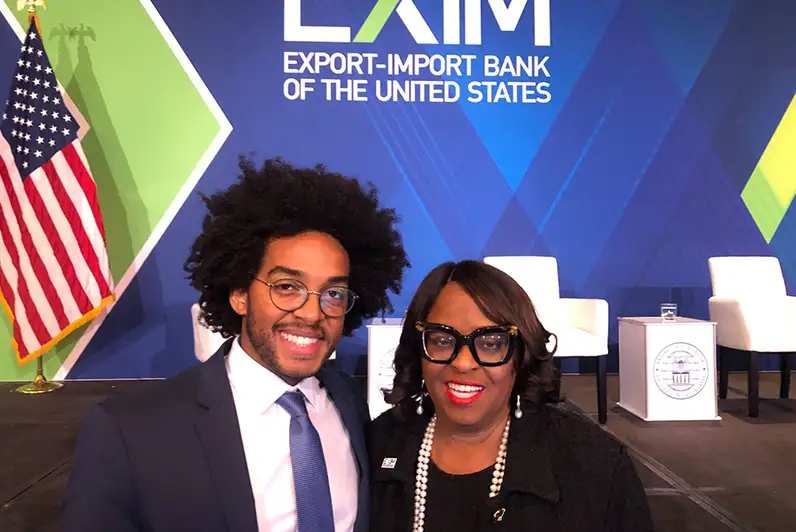
A major focal point of the conference was the enhancement of strategic relationships between the US and Africa. This goal could well be on its way to getting accomplished considering the major African players who were in attendance. Some of the African impact leaders who were in attendance included Denis Sassou Nguesso (President of the Republic of the Congo), Samaila Zubairu (President and CEO of Africa Finance Corporation), Benedict Oramaha (President and Chairman of Afreximbank), Ibrahim Magassa (President and Managing Director of Algest Investment Bank), Tein T.S. Jack-Rich (Founder & President of Belemaoil), Tony Elumelu (Nigerian Economist and Chairman of Heirs Holding), and many others.
I had the pleasure of sitting down with one of these extraordinary gentlemen to get further insight into how this initiative impacts his vision for the future of Africa and the US. He was kind enough to sit down for an interview in between his meetings in DC.
The Franco-Ivorian President of a prominent Investment Bank, and Harvard graduate, has strategically positioned himself as an open door to invest and grow with Africa. His Paris based bank specializes in structured and innovative financing for large companies and governments. With offices in Abidjan and in Brazzaville, the Investment Bank understands how to better advise its clients, structure deals and present business opportunities in Africa to foreign investors.
I prompted the Bank President with the question, “What does this visit to Washington DC mean to you?” His passionate response was equally eye opening and inspiring. He expressed, “The US Africa Summit is the place to be. It is where American investors, lenders and leaders meet in order to create a win-win partnership with the US and Africa moving forward. I saw everyone getting involved and I think that we will do something big. It’s about being effective and seeing the real opportunity. You can see that the people are very excited and motivated. This is a new page in the book for Africa and the US.”
The Bank President went on to tell me more about his investment bank and how it has been positioned to be a leader in the Africa and US partnership moving into the future, and said, “At the Investment Bank we have a big portfolio opportunity. We will explore how we can work with EXIM US and discover how we can make all these opportunities come to life. This includes renewable energy, technology, telecommunications, and the list goes on. The country has lots of financing opportunities and new innovations.”
For him, it was more than just attending a conference and having meetings. The true impact was in following up and taking action on the connections made. With confidence he stated, “Africa is a rich continent but there’s a development gap within the population. This just means there are more opportunities for growth.”

This was followed by some staggering statistics that began painting a compelling picture of his convictions. He went on to recite that, “The population of Africa will be 2.5 billion by the year 2050, 70% of the population will be under the age of 35, and the GDP will be 29,000 billion. 1 billion using mobile phones and 1 billion living in cities. There is a huge opportunity for infrastructure development. These figures prove the potential of Africa and how it will be the future of the world and a free market for the United States to invest in and grow with.”
He went on to express his gratitude to the U.S. Government and President Joe Biden for organizing such a great opportunity for African and US interests alike. There’s no doubt that the Bank President is a firm believer that Africa is the future of the world. I took a chance and asked him a much more direct question, “What do you specifically look to gain from these events?”
Though his response felt powerfully ambitious, for him it was very achievable. With calm conviction he said, “My main goal is to set up a minimum of 20 billion dollars in a pipeline to execute projects for the next three years. That way all those who want to do business in Africa can come to us.”
As if that wasn’t enough, he closed the conversation with the following statement, “The one who will win Africa, will be the one who will win the entire world.”
Now if that’s not some food for thought, I don’t know what is. A once popularized rhetoric that emphasized the unmet needs of Africa is rapidly transforming into a brewing belief that the continent can offer many mutual growth opportunities to the global market, and in this case, specifically to the United States of America.
At the close of the US Africa Business Forum Dinner on the eve of the U.S. Africa Summit, Dana Banks (Special Assistant to the President, NSC Special Advisor for the African Leaders Summit and The White House) in her final remarks to the special invites stated the following, “I’ve been preparing the President for his address tomorrow. This is Africa’s century. Cheers to Africa.”
We don’t know what tomorrow holds but it’s clear that the visionaries of Africa and the U.S. believe that a brighter future involves Africa and the U.S. building, growing and moving forward together.
Welcome back to 2025. Reflecting on our journey to the not-so-long-ago past, it’s evident that while much has changed in Washington D.C. and across the nation, one constant remains: Africa’s ascent on the global stage. Projections indicate that Africa’s economic growth will strengthen from an estimated 3.4% in 2024 to 3.7% in 2025, and further to 4.0% in 2026. Los Angeles, as a global powerhouse, has been actively engaging in this growth narrative. Initiatives like the LA-Africa Economic Strategy aim to deepen economic ties between our city and African nations, fostering mutual growth and understanding.
As we ponder this evolving reality, let’s consider how we, as Angelenos, can contribute to and benefit from this global vision of growth between Africa and the U.S. Thank you for journeying through this reflection with me. Remember, success is within our grasp. I hope you all had a blessed Black History Month, until next time.
Learn more at https://www.gianlucagibbons.com/

Gianluca Gibbons MBA, a trilingual Bermudian storyteller, saxophonist, and Sydney Palmer founder, a firm driving business growth through storytelling and community engagement. His motto, “We tell stories for a living, so dreams can live forever.”