

I’ve watched I Feel Pretty more times than I’d like to admit, and every time I notice something different. It’s about permission.
Amy Schumer’s, I Feel Pretty was marketed as a comedy about beauty, but I think it quietly tells a much more profound story. At its core, it isn’t about appearance at all. It’s about permission.
Nothing about Renee Bennett actually changes. She doesn’t lose weight. She doesn’t wake up looking like a supermodel. Her job, apartment, friends, and body remain exactly the same. The only thing that changes is what she believes about herself and somehow, everything changes.
Before the accident, Renee lives the way many of us do. She constantly compares herself to other women, assumes she’s less attractive, and quietly convinces herself that certain opportunities belong to “people like them.”
She works in the basement because she assumes that’s where she belongs.
Nobody forces her downstairs.
Nobody says, “You’re too unattractive to work upstairs.”
She decides that for herself.
She doesn’t apply for the job she really wants because she doesn’t think she’s polished enough. She second-guesses herself before anyone else has the chance.
Then she hits her head.
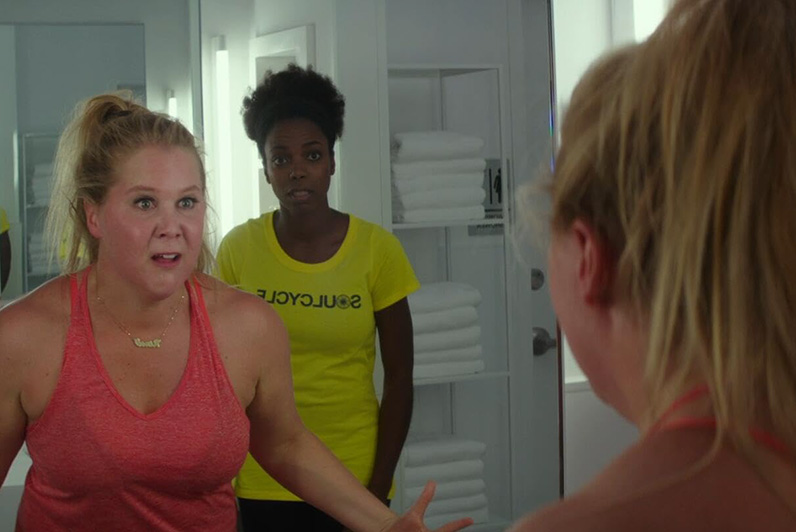
She looks in the mirror and suddenly believes she’s the most beautiful woman in the world.
The audience laughs because we know nothing has changed.
That’s exactly the point.
What follows isn’t a makeover.
It’s an experiment.
She walks upstairs. She applies for the job she wants.
Renee starts walking into rooms like she belongs there. She speaks confidently in meetings. She flirts without apologizing for existing. She compliments other beautiful women instead of competing with them because she no longer believes beauty is a limited resource.
One of my favorite scenes is when she’s surrounded by models and casually says,
“Aren’t girls like us so lucky that we can shop, like, anywhere and still look fly as hell?”
The humor comes from her complete sincerity.
She genuinely believes she belongs.
No one starts treating her differently because she’s prettier. They respond differently because she presents herself differently. Confidence changes conversations. It changes posture. It changes eye contact. It changes the opportunities we’re willing to pursue.
The sweetest part of the movie is that Renee doesn’t become arrogant.
She becomes grateful.
She treats a receptionist position at her dream company like she’s won the lottery while everyone around her dismisses it as insignificant. She lights up simply because she feels lucky to be there.
That enthusiasm is contagious.
Some people see delusion.
I see freedom.
Imagine how much of our lives are shaped by invisible rules we’ve created for ourselves.
“I’m not attractive enough.”
“I’m not experienced enough.”
“I’m not successful enough.”
“I’ll do that once I lose ten pounds.”
Most of us spend years waiting for external validation before allowing ourselves to fully participate in our own lives.
Renee accidentally skips that step.
By the end of the movie, the illusion disappears.
She looks in the mirror and sees herself exactly as she always has.
But now she understands that the confident woman she admired was never a different version of herself.
She was simply herself without fear.
That’s what makes I Feel Pretty more than a romantic comedy.
It’s a reminder that while confidence can’t change your reflection, it can completely change your experience of the world.
And maybe that’s the real transformation we’ve been chasing all along.
She physically moves into the space she thought belonged to someone else.
How many of us do the same thing?
We stay in the metaphorical basement because we’ve convinced ourselves we’re not ready.
When I started my business, no one officially told me I was ready.
No one handed me a certificate declaring me a business owner.
I had to decide that for myself.
Most of us aren’t waiting to become qualified.
We’re waiting to feel qualified.
Those are two very different things.
That’s exactly what her character teaches.
She doesn’t become confident because her life changes.
Her life changes because she starts acting before she feels she deserves it.
Maybe that’s why this film resonates years later.
Not because most of us dream of waking up looking different.
But because many of us are still waiting for someone to tell us we’re allowed to take up space.
Apply for the promotion.
Start the business.
Wear the swimsuit.
Speak up in the meeting.
Walk upstairs.
Maybe permission was never coming.
Maybe it was always ours to give.
We all have an “upstairs office” in our lives, the promotion, the business idea, the creative project, or the relationship we secretly believe belongs to someone else.
The biggest barrier is often invisible.
It’s the permission slip we’ve been waiting for that no one else was ever supposed to write.

Julia Payan is a licensed esthetician and founder of Just Be Gold Spa. She is passionate about partnering with clients on their skincare goals to nurture their natural beauty and sharing actionable tips to elevate your beauty routine.